
UPDATE
April 21.2025
2 Minutes Read

Recovering History: The Significance of the Hernandarias Manuscript Return to Paraguay

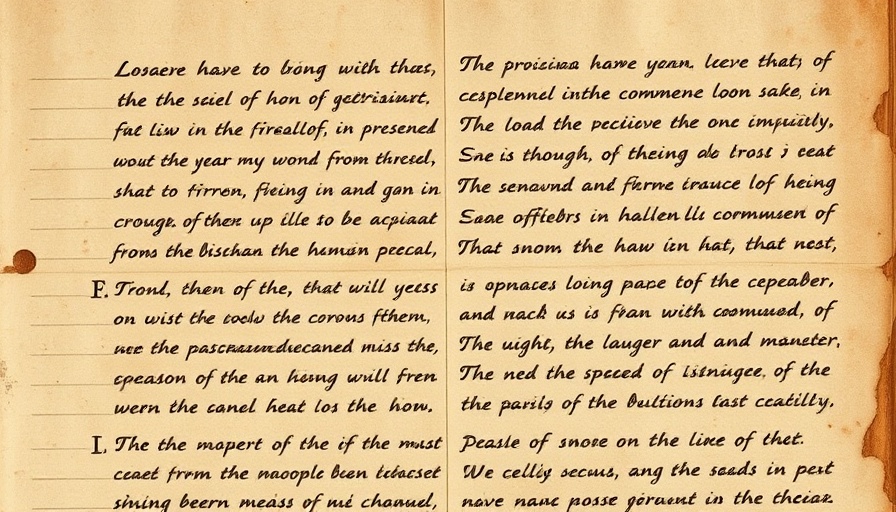
Returned 16th century manuscript from Paraguay, faded ink on aged paper.

Unraveling the Nest of History: The Hernandarias Manuscript

In a remarkable turn of events, the Hernandarias Manuscript—a unique 16th-century document—has been returned to Paraguay after being stolen from its National Archives over a decade ago. This 13-page manuscript, penned by Hernando Arias de Saavedra, a Spanish colonial governor, plays a vital role in Paraguay's history and cultural identity.

Preserving Cultural Heritage: A Shared Responsibility

The repatriation of the manuscript highlights the importance of preserving cultural artifacts. District Attorney Alvin Bragg emphasized, "This manuscript is seen as an important precursor to Hernandarias’ 1603 abolition of the punitive encomienda system, a form of exploitation faced by Indigenous peoples." The act of repatriating such significant items is a vital step toward acknowledging and rectifying historical injustices.

The Road to Recovery: Community and Diplomacy in Action

Thanks to a tip from the Paraguayan Consulate in New York, the Manhattan D.A.'s Antiquities Trafficking Unit (ATU) began an investigation leading to the manuscript's recovery. District Attorney Bragg’s efforts not only showcase the commitment to legal excellence but also highlight the role of international cooperation in safeguarding heritage.

The manuscript was last listed for sale at Martayan Lan in Manhattan, where it was priced at $18,500. The auction house reportedly believed the sale was legitimate, yet historical records indicating its stolen status emerged during the investigation. This case exemplifies the complexities of art and artifact sales in relation to cultural property laws.

Reflecting on Paraguay’s Cultural Identity

The Hernandarias Manuscript is more than just an artifact; it represents the ongoing relationship between Paraguay’s past and its present. As noted, the Guaraní people, central to Paraguay’s identity, continue to thrive, and their language remains one of the nation’s official tongues. The return of this manuscript serves as a reminder of the enduring significance of cultural heritage and the responsibilities we hold towards one another across borders.

A Global Call to Action

With this significant event, we are reminded of the importance of vigilance in protecting cultural artifacts. As individuals, we can enrich our understanding of global history and advocate for the preservation of cultural heritage in our communities. Stay informed and engaged to appreciate the profound impact of such repatriation efforts on societies worldwide.

World News

0 Comments

Write A Comment

*
*
Please complete the captcha to submit your comment.
Related Posts All Posts

Trump’s Announcement to Send 5,000 Troops to Poland Raises Questions

Update Trump's Surprising Announcement In a startling turn of events, President Donald Trump announced that the United States will be sending an additional 5,000 troops to Poland. This revelation comes as an apparent u-turn following recent statements by his administration to reduce the U.S. military presence in Europe by about 5,000 troops. Trump's declaration seems to deepen the confusion surrounding U.S. military deployments, leaving many observers scratching their heads. Context Behind the Decision The announcement was made against the backdrop of tensions related to NATO and the ongoing war in Ukraine. Trump's relationship with Poland’s newly elected President, Karol Nawrocki, appears to play a role in this decision. Nawrocki’s electoral success, which Trump had publicly supported, has led Trump to formalize this troop deployment, asserting that it reflects a productive alliance. However, the recent fluctuations in U.S. troop levels have raised questions about consistency in military commitments in Europe. Reactions from European Allies Trump's announcement has met a mixed response. While Polish officials have expressed gratitude, stating that the U.S.-Poland alliance is vital for security, other European leaders are bewildered by the seemingly erratic military strategies from the Trump administration. Critics, including both Republican and Democratic lawmakers, have referred to the recent troop deployments as "blindsiding" for Poland, arguing that the uncertain U.S. posture sends a troubling signal to allies amid ongoing tensions with Russia. Potential Implications for NATO This convoluted situation raises concerns about the reliability of the U.S. as a NATO ally. With the backdrop of NATO's ongoing struggle to maintain a unified defense against Russian aggression, any ambiguity in U.S. military presence could have long-lasting implications. As the discussions around troop levels continue, experts are noting that clarity and consistency in communications are essential, especially while allies look for assurance amid mounting pressures from Moscow. What’s Next for U.S. Troops? As the Pentagon has referred inquiries regarding troop logistics back to the White House, further details remain sparse. There are questions about where these additional troops will be sourced from and whether they will indeed bolster the existing U.S. military footprint in Poland, an essential hub for U.S. aid to Ukraine. With escalating tensions in Europe, the outcomes of these military decisions will be pivotal in shaping future U.S.-NATO relations.

Exploring Marco Rubio's Claims Against Cuba: A Threat to the US?

Update The Tension Between America and Cuba: A Longstanding RivalryFor decades, the relationship between the United States and Cuba has been one fraught with tension. This animosity intensified following the Cuban Revolution in 1959 when Fidel Castro established a communist regime, leading to an American embargo that has shaped U.S.-Cuba dynamics since. Recently, U.S. Secretary of State Marco Rubio labeled Cuba as a "threat" to the United States, asserting that its leadership's actions directly harm the Cuban people, echoing long-standing criticisms of governmental mismanagement on the island.Rubio's Offer to Cuba: Change or Continuity?In a bold declaration on Cuban Independence Day, Rubio proposed not only a new relationship but also $100 million in humanitarian aid aimed at alleviating the stark shortages faced by Cubans. However, this proposal came with conditions, including the crucial requirement that Cuba's military-run conglomerate, GAESA, be excluded from the distribution of aid. Rubio's argument hinges on the belief that corruption and greed among Cuba's leaders are the primary sources of the island's ongoing crisis, exacerbating already dire conditions regarding food, fuel, and healthcare.Cuba's Response: Accusations of DeceitIn sharp contrast, Cuba's embassy in the U.S. openly accused Rubio of deception, claiming his statements serve to justify aggressive U.S. policies that contribute to the strife experienced by ordinary Cubans. The Cuban government insists that the real roots of its difficulties lie in the relentless pressure and sanctions imposed by the United States, which they argue stifle the nation's economy and exacerbate humanitarian issues. These assertions highlight the complexity of the discourse surrounding U.S.-Cuba relations and the differing narratives that shape the situation.The Broader Implications: What Lies Ahead for U.S.-Cuba Relations?As tensions remain high, the future of U.S.-Cuba relations hangs in the balance. While Rubio's offer could be seen as a potential pathway towards dialogue and cooperation, much skepticism exists on both sides about the sincerity and feasibility of such proposals. Whether this moment marks the beginning of a new chapter or simply reinforces the status quo is still to be determined, as deep-seated distrust and political calculations continue to complicate matters.The Humanitarian Crisis: Why It MattersAmidst this backdrop of political posturing, the pressing humanitarian issues facing Cubans cannot be overlooked. With ongoing shortages leading to widespread suffering, any potential alleviation through U.S. aid prompts significant debate. For those looking at this situation with a professional focus—lawyers, accountants, and medical professionals in particular—understanding the nuances of these developments is essential, as they may influence international regulations, economic policy, and healthcare initiatives moving forward.

US Charges Raul Castro with Murder: Historical Context and Future Implications

Update The Indictment of Raúl Castro: A Long-Awaited Justice On a historic day for Cuba and Cuban Americans, U.S. federal prosecutors have charged former Cuban President Raúl Castro in connection with the 1996 downing of two civilian aircraft operated by the Miami-based group Brothers to the Rescue. The announcement, delivered by Acting Attorney General Todd Blanche, has marked a notable escalation in U.S.-Cuba relations, as families of the victims have been awaiting this moment for nearly three decades. The indictment cites Castro's role as defense minister at the time of the incident, claiming he conspired to kill U.S. nationals and was complicit in the actions that resulted in the tragic deaths of four men who were engaged in humanitarian missions to assist Cuban refugees. While the attack occurred in international waters, Cuba has maintained that the aircraft violated its airspace, a defense widely disputed internationally. Reactions from the Families For the families of the victims, like Marlene Alejandre, who lost her father in the incident, the announcement comes as a long-awaited relief. "I’ve been waiting 30 years for this," expressed Alejandre, highlighting the emotional toll the event has had on her and others affected. The sentiments echoed across many families present at the Freedom Tower in Miami, a significant venue symbolizing Cuban resilience and memory. The Political Ramifications Cuba’s current leadership has reacted strongly to the indictment, with Miguel Diaz-Canel dismissing it as political theatrics aimed at justifying military aggression against Cuba. Experts suggest that this move might serve not only to appease U.S. constituents, particularly Cuban exiles, but also potentially backfire by consolidating the Cuban government’s hardliner base. Understanding the Historical Context This indictment revives memories of an incident that significantly impacted U.S.-Cuba relations. On February 24, 1996, two planes were shot down, leading to heightened tensions and the establishment of policies still affecting diplomatic interactions today. The enduring ramifications of the Helms-Burton Act, which emerged in response to this incident, continue to frame the U.S. approach to engaging with Cuba. Future Perspectives: What Lies Ahead? As the Trump administration leverages this indictment, questions arise about its broader intentions. Scholars like Orlando Perez suggest that this could be a strategy tied to upcoming midterm elections, seeking a political win amidst declining approval ratings. The pathway forward remains uncertain, but the indictment has reinvigorated discussions about accountability and justice in U.S.-Cuba relations. Conclusion: A Call for Justice and Accountability This indictment represents a significant moment not only for the families of the victims but also for the ongoing narrative of U.S.-Cuba relations. The pursuit of justice for actions taken against American citizens has gained renewed urgency, suggesting that accountability may finally be within reach. As this story unfolds, the implications may reach far beyond the courtroom, potentially impacting future diplomatic conversations. For professionals in law, finance, and healthcare, staying informed about developments like this can shed light on how international relations potentially influence broader economic and social policies. It invites reflection on the complexities of geopolitical interactions and their human costs.

Terms of Service

Privacy Policy

Core Modal Title

Sorry, no results found

You Might Find These Articles Interesting

T
Please Check Your Email
We Will Be Following Up Shortly
*
*
*